Goodyear's residential construction pattern matters here. Subdivisions like Centerra, Canyon Trails, and Copper Springs were built in the mid-2000s through the 2010s on 200-amp services with standard tract layouts.…
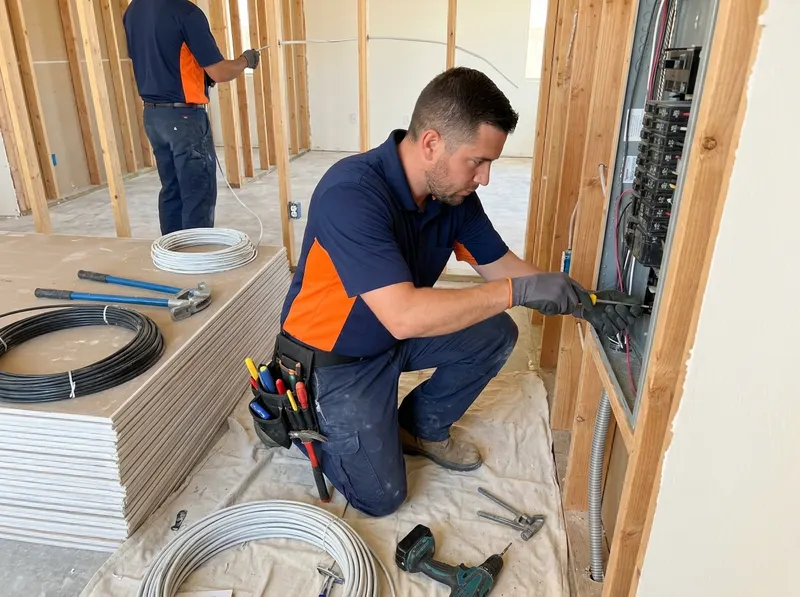
Goodyear's residential construction pattern matters here. Subdivisions like Centerra, Canyon Trails, and Copper Springs were built in the mid-2000s through the 2010s on 200-amp services with standard tract layouts. When a homeowner in one of those neighborhoods converts a three-car garage into a casita, adds a second kitchen island, or finishes a bonus room, the existing panel capacity has to be verified against the new load before a single wire is pulled. A remodel that adds a 240-volt range, a 20-amp dishwasher circuit, and four new 20-amp kitchen counter circuits can consume 60, 80 amps of new demand, a number that matters if the original panel is already running 150, 160 amps of summer AC load. That calculation happens first, not after the drywall is open.
New construction in active Goodyear communities, including newer phases of Estrella Mountain Ranch near Estrella Mountain Regional Park and the Sarival Farms area along the I-10 corridor, typically starts with a builder-supplied electrical plan, but those plans are often drawn to code minimums. Before rough-in begins, it is worth reviewing outlet spacing, dedicated circuit counts for the kitchen and laundry, and whether an EV-ready conduit stub-out or a solar-ready sub-panel space should be included while the walls are open. Adding a 60-amp sub-panel space or a 1-inch conduit for a future EV charger costs roughly $150, $300 during rough-in; retrofitting it after drywall runs $800, $1,500 or more. That is the kind of trade-off a diagnostic-first approach surfaces before the concrete is poured.
For remodels in established Goodyear neighborhoods like Pebblecreek or Wigwam Creek, homes built in the 1990s and early 2000s, the wiring material itself can shift the scope. Homes in that era may carry aluminum branch wiring on 15- and 20-amp circuits, which requires CO/ALR-rated devices or pigtailing at every connection point to meet current Maricopa County code. Discovering this mid-project adds time and cost; confirming it during the initial site visit keeps the schedule intact. Maricopa County requires rough-in inspection before insulation or drywall closes the walls, and a final inspection before any new circuit is energized, Clearvolt Electrician coordinates both phases directly with the county, so the GC or homeowner does not have to manage the inspection queue.
The process runs in four numbered steps: 1. Plan review and load calculation, the floor plan is reviewed, circuit counts are confirmed, and the permit application is submitted to Maricopa County. 2. Rough-in, all conduit, boxes, and wire are installed with walls open; the rough-in inspection is scheduled and passed before close-in. 3. Trim-out, devices, fixtures, and panel breakers are installed after drywall and paint. 4. Final inspection, Maricopa County inspects all completed work; the permit is closed and a copy is provided for the homeowner's records. Montecito and Cottonwood Ranch homeowners doing room additions through a licensed GC should confirm their general contractor's timeline includes electrical inspection hold points, skipping a phase inspection is the single most common cause of remodel delays on the West Valley permit queue.
Every job gets a firm, written price after a free on-site visit.
Tell us about your new construction & remodel wiring job in Goodyear and we'll send a clear, written quote, usually the same day.
 Clearvolt Electrician